I need a solid state relay to be actuated by a 24 vac control. The switched circuit is up to 20amps of 120vac. these 3 seem to be suitable for those parameters :
I would like to verify this, and to discover which one makes the most sense in comparison.
Hello @davecom7,
We would need to know more about your application to differentiate between the relays. For instance, what type of load will you be driving. The relays are AC-51 rated which implies that they are suitable for resistive lightly inductive loads. Also, do you need to build to UL-508A standards?
Sincerely,
Aaron
P.S. I modified you post to include part number links for the convivence of our readers and others who may add to this answer.
Welcome to the forum! These seem pretty adequate for the description you provided. My only feedback would be this: 3667-SUL842770-ND, the first option, may be best suited based on the wiggle room of the current. While the other devices can technically operate just fine at 20A, running something consistently at the maximum rating is usually not preferred. You push the electrical life by always running at the maximum for most parts, regardless of the technology. Most applications assume some kind of “wiggle room” on the amperage rating for worst case scenarios. If you are curious about other aspects, let us know what technical details you want to know.
Thank you for your reply. I am using this to remotely power on 3 video projectors (2 LED, 1 laser). The relay I have now is making a buzzing noise. So I need a quieter option. All of this is installed inside a metal enclosure per NEC. I have a suitable amount of wiggle room on the amperage for the load, as far as wiring. Is there a recommended percentage of wiggle room you recommend to prevent premature burn-out?
The general rule of thumb I’ve heard is about 80% of the expected load or supply capacity. This avoids premature failure. Consider breaking both hot and neutral though, that is a good practice in terms of safety. This isn’t typically very feasible with Solid State Relays due to how they function, though.
A few things to note:
First, the RGC1A23D15KKE can only be triggered with a DC input of 3 - 32 Vdc, but not with an AC input.
Second, the Siemens 3RF23201AA14 is not a stocking item and would require a non-stocking order, which would entail a lead-time of about 4 weeks.
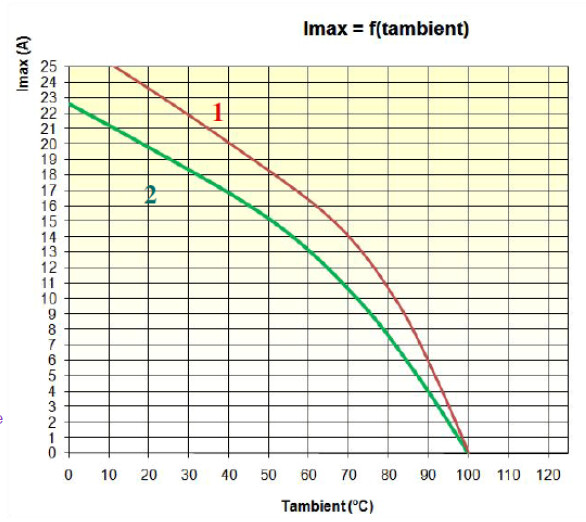
Third, pay close attention to the de-rating curves for these devices as the ambient temperature increases - particularly if using in an enclosed space. The current ratings listed for most SSR’s are assuming they will be operating at near standard room temperature, and must be de-rated as ambient temperature increases.
SUL842770 de-rating curve (see datasheet notes on page 3):
3RF23201AA14 de-rating curve (see datasheet page 6):
Unless you have very good air flow to maintain an enclosure temperature below 40°C, including the added heat produced by the current passing through the SSR, I would recommend going to a significantly higher current rated part such as the RGC1A23A30KKE, which will handle 20A resistive load up to 80.
Current De-rating vs. Temperature Graph from page 12 of the RGC1A23A30KKE datasheet: