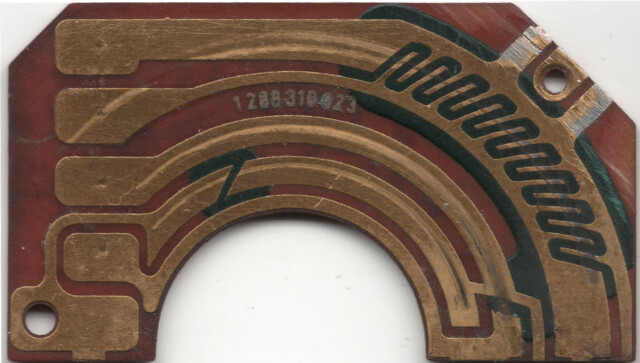
------Question for EE-SX1330 Please Put your question below------
I don’t know that the sensor above is exactly what I am looking for. I’m looking for an optical sensor that has the chopper wheel operating in the same plane of the PCB. It’s possible that I want multiple devices operating at different radii on the chopper wheel.
This is a pretty crucial component in an analog fuel injection computer called D-Jetronic. This device functions the same as the accelerator pump of a carburetor. The sliding wipers on different radii serve some different functions.
What I want to make sure of that any product I select can have the chopper wheel on the same plane of that PCB.
Thanks,
Dave F.
Hello,
Welcome to the TechForum.
I was not able to locate a good option to offer for this request. Hopefully another DigiKey tech can look this over and offer an idea. This question will remain active so most likely will have more information to offer.
Thank you
Ryan
The EE-SX1330 is designed for surface-mounted applications, and as such the plane of any detected object such as a code wheel etc will be normal to the sensor’s mounting surface. There are some items such as the OPB830W55Z available designed for right-angle mounting, though similar formats would not appear to be very popular.
One may wish to consider products from the encoder family, there are products in the analog reflective sensor family that might be useful for building a work-alike alternative, or also the phototransistors in conjunction with a similar light source.
1 Like
I have definitely thought of custom decoder wheels replacing the rotor, the rotating part which carries the four wipers in the second picture. The OEM was quite clever in ~1965 in having the rotor signal both the idle state and the wide open throttle state.
The “fingers” operate a flip-flop circuit, which add extra fuel injector pulses during acceleration. I can define the angular relationships, so I expect I would need a custom encoder, adding costs.
I will need to further research the reflective sensors and phototransistor families.
Thanks
The reflective sensors, phototransistors, and the part originally mentioned are all slightly different arrangements of the same two ingredients; an LED that makes light and a transistor that conducts when light hits it.
Original part has the two pointing at each other such that an obstruction results in transistor turning off, reflective device has them side-by-side so that a reflective surface sufficiently close causes the transistor to turn on, phototransistors require bringing one’s own light source and choosing how it gets mounted.
None of such existed in practical form circa '65, nor did modern manufacturing tech and services. I suspect that costs for a laser-cut slot wheel performing a similar function could rapidly approach sub-dollar territory at even modest volumes.