


Purpose-built spanners are available to tighten cable glands. An example is shown in Figure 1.
The primary advantage is speed. When compared to a wrench:
- The spring-loaded tool quickly clamps to the cable gland.
- The spring mechanism has ratchet-like action on the cable gland. Like a socket set, the tool does not need to be repositioned once it is set on the cable gland. This is critical when other objects such as walls or adjacent hardware prevent continuous rotation.
- The spanner’s arm has the height to reach over adjacent cable glands. Instead of constantly repositioning a wrench, the tool allows sweeping movements without interference.
This article is part of the DigiKey Field Guide for Industrial Automation
Location: Integrate It → Panel Construction.
Difficulty:  Student — difficulty levels explained
Author: Aaron Dahlen | MSEE | Senior Applications Engineer, DigiKey
Last update: 02 Jul 2026
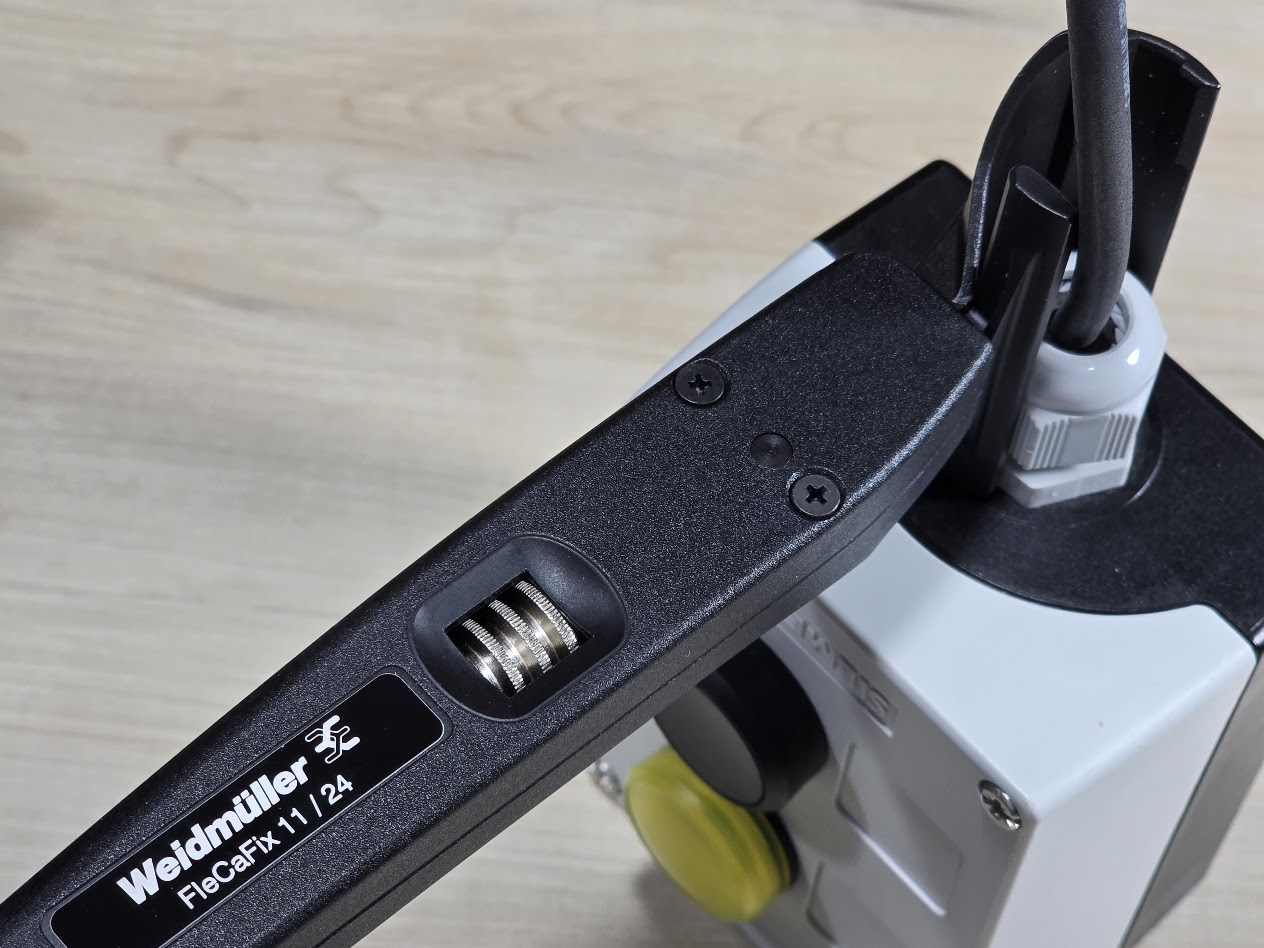
Figure 1: Weidmüller FLECAFIX 11/24 spanner positioned to tighten a cable gland.
When should the cable gland tool be used?
This is a labor-saving device that earns its keep in the field during final cable installation. It can save time on every cable gland installation. The actual time depends on the interference from adjacent objects. However, the ratchet-like operation is a joy to use when compared to a fixed wrench. This reduces frustration when working in a confined space where many cable glands are present.
The tool may allow you to place the cable glands closer together. For every pro there is a con as field technicians may struggle with the installation unless they have the tool.
Where can I purchase a cable gland spanner?
The representative tools shown in this article are:
-
Weidmüller FLECAFIX 11/24 for 11 to 24 mm cable glands
-
Weidmüller FLECAFIX 24/36 for 24 to 36 mm cable glands

Figure 2: Side-by-side comparison of the Weidmüller tools.
What precautions are associated with the tool?
Over-torquing is a hazard as the spanner has a long lever arm. In my opinion, this is a hazard associated with all wrenches because it is too easy to be overzealous.
Refer to the cable gland datasheet for torque specifications (when available). Provide training for your assemblers as correct cable gland installation is a long-term investment in equipment reliability.
 Continue Exploring Industrial Control Systems
If this discussion was helpful, you may also want to explore:
 DigiKey Navigation
- Full Catalog: Industrial Control & Automation
 Related Foundational Articles
About This Author
Aaron Dahlen, LCDR USCG (Ret.), is a Senior Applications Engineer at DigiKey in Thief River Falls. His background in electronics and industrial automation was shaped by a 27-year military career as both technician and engineer, followed by over a decade of teaching.
Dahlen holds an MSEE from Minnesota State University, Mankato. He has taught in an ABET-accredited electrical engineering program, served as coordinator of an electronic engineering technology program, and instructed military technicians in component-level repair.
Today, he has returned to his home in northern Minnesota, completing a decades-long journey that began with a search for capacitors. Read his story here.